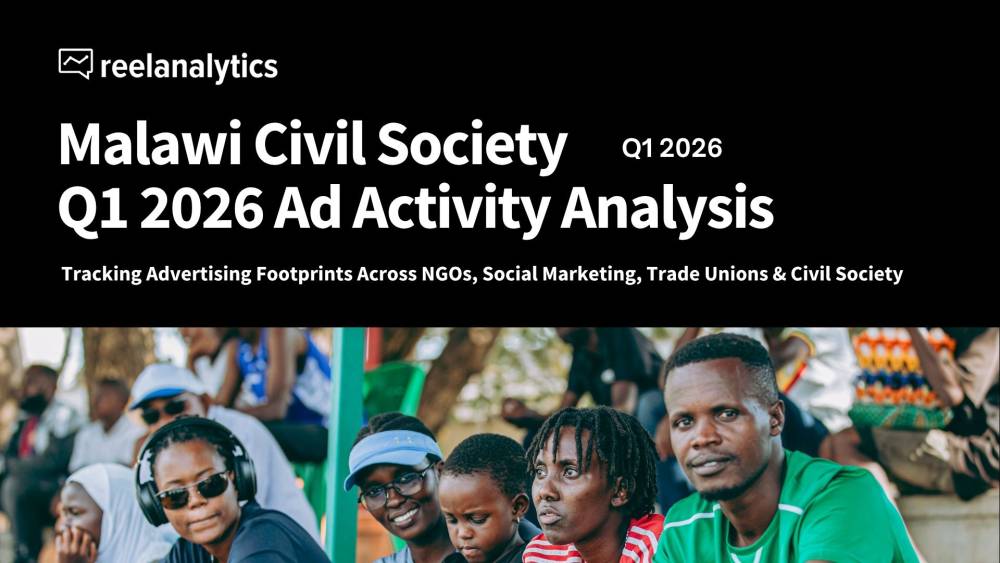
This focused analysis offers a deeper dive into Malawi's society sector, revealing how NGOs, social marketing initiatives, trade unions and civil society organisations manage their advertising across a heavily donor-funded communication landscape.
Discover the strategies that set these organisations apart and how they are navigating one of the country's most concentrated media environments.
We analysed 35 organisations advertising across six sub-industries on 18 electronic media stations during the quarter (Q1 2026), covering 6,458 advertisements in total. The findings point to general patterns in category investment, channel usage and communication approach across the sector, offering a useful reference point for organisations and brands thinking about their own media strategy.
This report features advertising insights on TV, radio and print for the period of January-March 2026.
In this report:
- Media Spend Trends
Radio absorbed almost all advertising activity (95.6%), while television carried a supplementary 4.3% and print accounted for just 0.11% only seven placements across six organisations. This lean toward radio reflects its position as Malawi's most trusted and accessible platform in a country where more than 70% of the population lives in rural areas.
- Leaders In The Category
NGOs led all sub-industries by a wide margin, accounting for 92.2% of society advertising with 5,952 ads, ahead of social marketing at 4.9% and trade unions at 2.5%.
- Unique Strategies
The World Bank pursued depth over frequency: despite ranking fifth by ad volume (464 ads), it recorded the longest average spot at an estimated 147.6 seconds, generating more than 68,000 seconds of airtime, a clear direction toward detailed, development-focused messaging over raw repetition.
- Media Dominance
Concentration is high across the sector. The top five advertisers accounted for roughly 86% of all society advertising, while the remaining 30 organisations together held around 14%.
How This Report Can Inform You:
- Stay Ahead of Competition
Notice shifts in the market by understanding where visibility is genuinely concentrated among a few established players such as the European Union, Development Media International and the World Bank versus where the landscape remains lightly contested, such as social marketing (4.9%), trade union messaging (2.5%) and the growing community radio ecosystem that offers direct access to underserved rural audiences.
- Optimise Media Mix
Use these sector-wide patterns as a rough benchmark for thinking about where your own media investment might be under- or over-weighted across radio and television, particularly given radio's near-total dominance and television's supplementary role in reaching mass audiences.
- Engage Consumers Effectively
Gain a broad sense of how sub-industry, channel allocation and communication quality shape effectiveness across the sector. Use these general patterns, including the shift toward longer-form, behaviour-change content, as a starting point for thinking about your own audience approach.
About Reelanalytics
Reelanalytics provides brands and organisations with value-added information built on insights, recommendations and actionable truth to grow their brands.
We partner with our clients to help them understand people and markets so that they can develop and execute effective media, marketing and communication strategies.
At Reelanalytics, we employ sound approaches to researching trends, market shifts and economic data so that the information our clients receive is value-added for effective decision-making.